A Kenyan's Path into the Space Industry: Peter’s Journey with STAR.VISION
Aug 3, 2026 @STAR.VISION
Growing up in Kenya, space was something that happened to other people. It was rockets on the international news channels, or the kind of thing you studied for an exam and then forgot. Nobody I knew grew up saying "I want to work in space." We wanted to be doctors, engineers, pilots - careers you could point to and explain in one sentence at a family gathering. "Space" was not on that list. It still isn't, for most people back home.
The Pivot: From Rockets to Data
My perspective began to shift during university, where I gradually realized that tremendous practical problem-solving potential lay not in rockets themselves, but in space-derived data. As AI and automation reshaped the workflow of data analysis, I became deeply fascinated by spatial deep learning, a field that still occupies most of my thinking today. Therefore, when a competition calling for remote sensing AI algorithms for space was announced, I did not hesitate to sign up. It struck me as exactly the opportunity to practice the theories I had only read about in textbooks.
A Life-Changing Competition
In 2024, as a member of the Remote Sensing Research Group at DEDAN KIMATHI UNIVERSITY OF TECHNOLOGY (DeKUT) under the supervision of Dr. Kuria B. Thiong’o, our team developed an AI algorithm for vegetation health monitoring for the Spaceborne AI Rideshare Algorithm program. This joint initiative was co-launched by the Kenya Space Agency and STAR.VISION, a Chinese aerospace enterprise that I barely knew about at that time. Our team claimed second place, and for a long time, this achievement alone felt like the biggest milestone.
_0351c60f.png)
_576769ae.jpeg) Peter with the Director-General of the Kenya Space Agency
Peter with the Director-General of the Kenya Space Agency
What I didn't know then was that second place would open a door I hadn't even seen. It earned our team a spot at the Space Summer Camp 2025, and from there, an invitation followed that I genuinely did not see coming: a three-month Global Space Winter Internship at STAR.VISION's headquarters in Hangzhou, China.
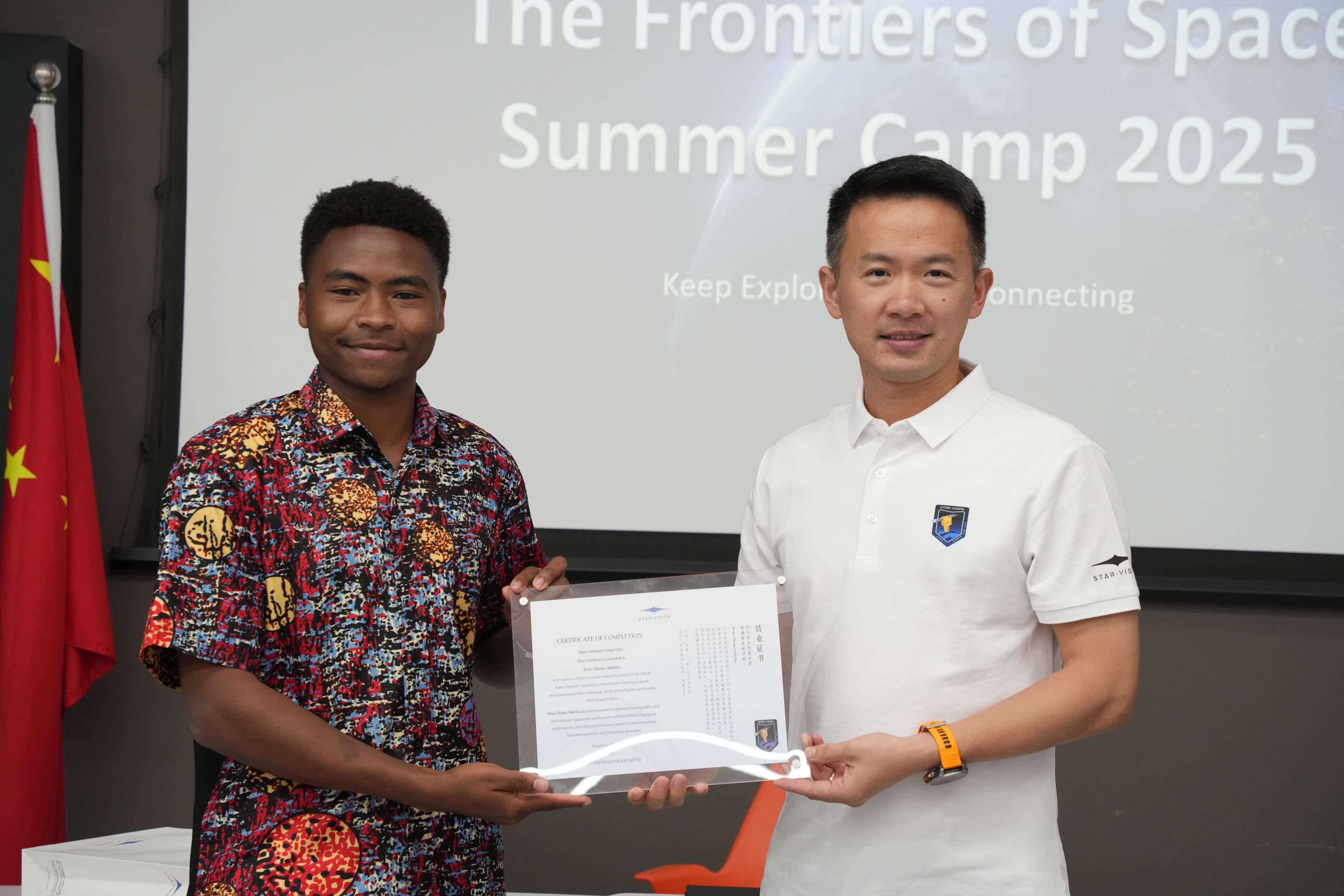
_a4307c54.png) Closing Ceremony of Space Summer Camp 2025
Closing Ceremony of Space Summer Camp 2025
_c77d8fcb.jpeg) Peter with other winter internship participants
Peter with other winter internship participants
From Student Researcher to Solutions Manager
During those three months of internship, I shifted from an onlooker to an active technical contributor. I participated in diverse projects, each teaching me practical experience unavailable in classrooms. What followed still surprises me whenever I mention it aloud: my internship performance secured a full-time offer, and I now serve STAR.VISION as a Business & Solutions Manager. My daily work involves communicating with clients and translating satellite technological capabilities into targeted solutions for their real-world challenges. This journey has brought me valuable humility. I quickly learned that even the most sophisticated AI model is meaningless if you cannot concisely explain its practical value to paying clients.
_727585cc.jpeg) Meet with Mr. Hamid Mehmood, Head of the UN-SPIDER Beijing Office
Meet with Mr. Hamid Mehmood, Head of the UN-SPIDER Beijing Office
I share my story not to polish my experience into a neat, perfect narrative. I hope young people in my home country understand that the leap from university research labs to international AI and aerospace companies is far less unattainable than it seems from the outside. STAR.VISION is a pioneering space-tech enterprise focusing on AI satellite technology, space computing and deep-space exploration. After more than one year witnessing the company’s development, I confirm this positioning is far more than marketing slogans; it is a promising mission worth devoting myself to.
_b427677e.png)
The Next Frontier: In-Orbit AI
If I had to bet on where this industry goes next, it isn't just more satellites going up - it's smarter ones. The real shift I see coming is in-orbit AI: algorithms that process imagery directly in-orbit. Space computing, in that sense, is what cloud computing did for the internet - infrastructure that becomes invisible precisely because it works, until people simply expect answers in real time rather than after a long download. For an industry that used to measure turnaround in weeks, that's not a small shift. It's the difference between a satellite that only observes and one that can actually decide. And it's exactly where STAR.VISION has placed its bet as a manufacturer of AI-powered satellites.
What Satellite Intelligence Means for Africa
This leads me to the issue I care most about: how space technology will benefit Africa. I have witnessed firsthand how AI and satellite technology resolve practical regional challenges when applied properly. STAR.VISION is preparing to launch two OSE hyperspectral AI satellites (HS01/02). Regular, affordable monitoring, once only achievable through costly, occasional aerial surveys, will become accessible across Africa. The continent rarely lacks ambition; what it lacks is stable, low-cost geospatial data. I am eager to witness the launch of these twin hyperspectral satellites in person during Space Summer Camp 2026, and I firmly believe the data collected will reshape the agricultural economy of Kenya and the entire African continent.
_950c04fd.png) OSE Hyperspectral Satellite Under Assembly
OSE Hyperspectral Satellite Under Assembly
_4952f6cf.png) Peter introduces the hyperspectral satellites
Peter introduces the hyperspectral satellites
A Call to the Next Generation
That's the case I'd make to any young space enthusiast, African engineer, data scientist, or geographer weighing whether this space industry is "for them": it is, and increasingly, it needs you specifically. Back at home, Kenya Space Agency e Agency has set out a strategic plan through 2027 that leans hard on exactly this kind of human capital, and programmes like the one that brought me here are one of the more direct ways of building it. I came in as a researcher with a second-place finish. I'm writing this as someone who now helps decide how satellite intelligence gets pitched to the people who might use it to fix something real.
_4a6dce67.png) Peter introduces satellite AI technology to participants of Space Summer Camp 2026
Peter introduces satellite AI technology to participants of Space Summer Camp 2026
In conclusion, there's a lot of work still ahead-for us young space professionals, and for Africa's place in this global space industry. I'm very glad to be part of building it rather than watching it from the outside and thankful to the entire STAR.VISION family for the opportunity to work and grow together.
_54a75a7f.jpeg) Peter and participants of Space Summer Camp 2026
Peter and participants of Space Summer Camp 2026


Stay Informed
Subscribe STAR.VISION’s Newsletter

If you would like to receive email updates from STAR.VISION Newsroom, please complete the information above.